Learning to DJ as a Beginner: an 8-Step Path
Learning to DJ as a beginner usually starts with three questions: where do I start, is it hard, and what do I need? The short answer: if you love music and practise regularly, you can learn it. You don't need music theory or an instrument first. The hard part is training your ears and staying patient, not the gear. Here's what our teachers at Muse Inc tell new students in their first lesson — and if you're an expat or just passing through Saigon, our lessons run in English too.
What a DJ actually does
A DJ picks music and links tracks into one continuous flow, steering the energy of the room. From the dance floor it can look like pressing play and turning a few knobs. Behind the decks, you're doing four things at once: choosing the next track, matching the beats of two tracks, deciding when to transition, and watching how the crowd reacts.
So the foundations are knowing your music (genres, BPM, song structure), solid mixing technique, reading the crowd, and staying calm when a USB fails or a track drifts off beat.
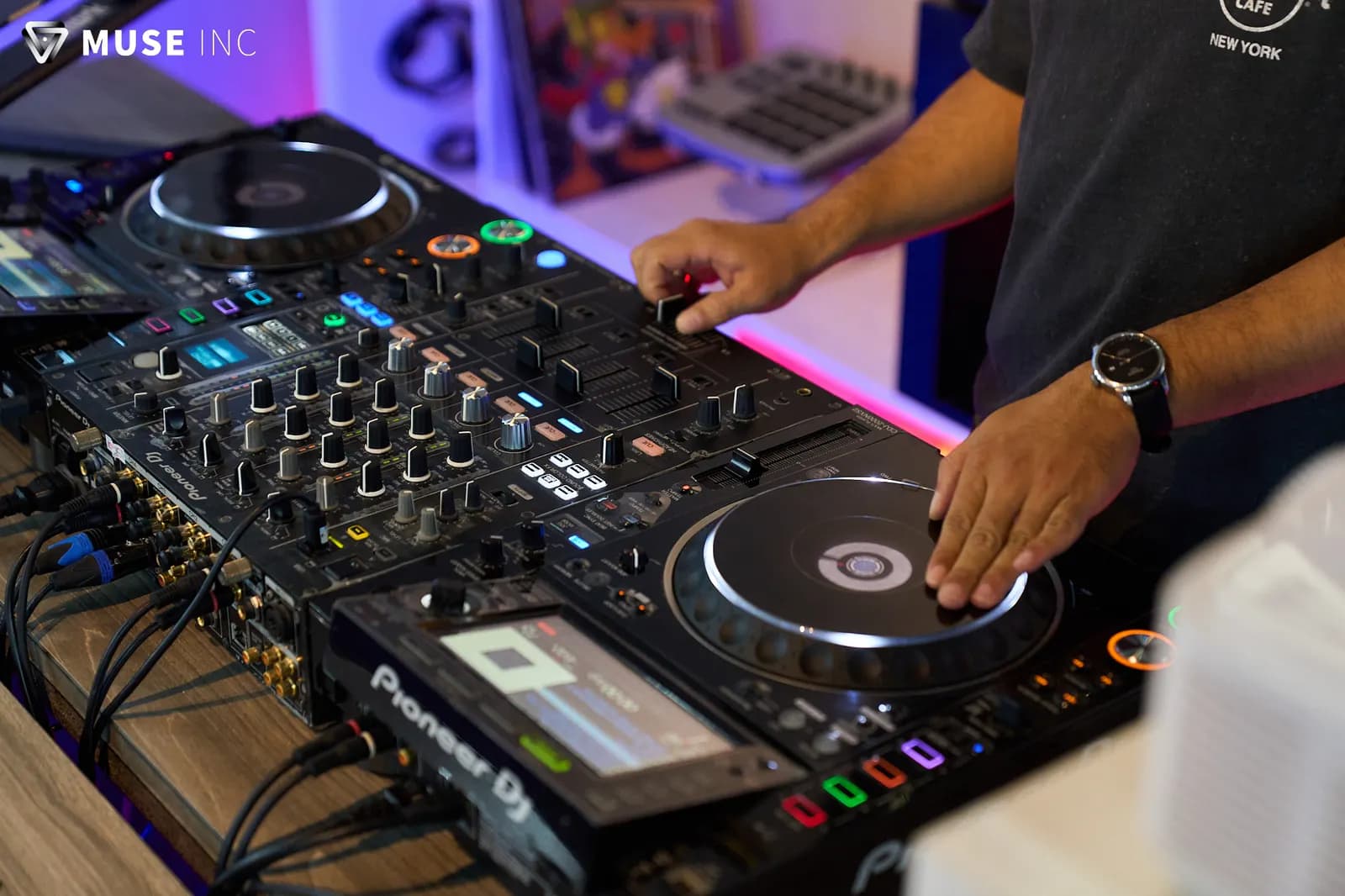
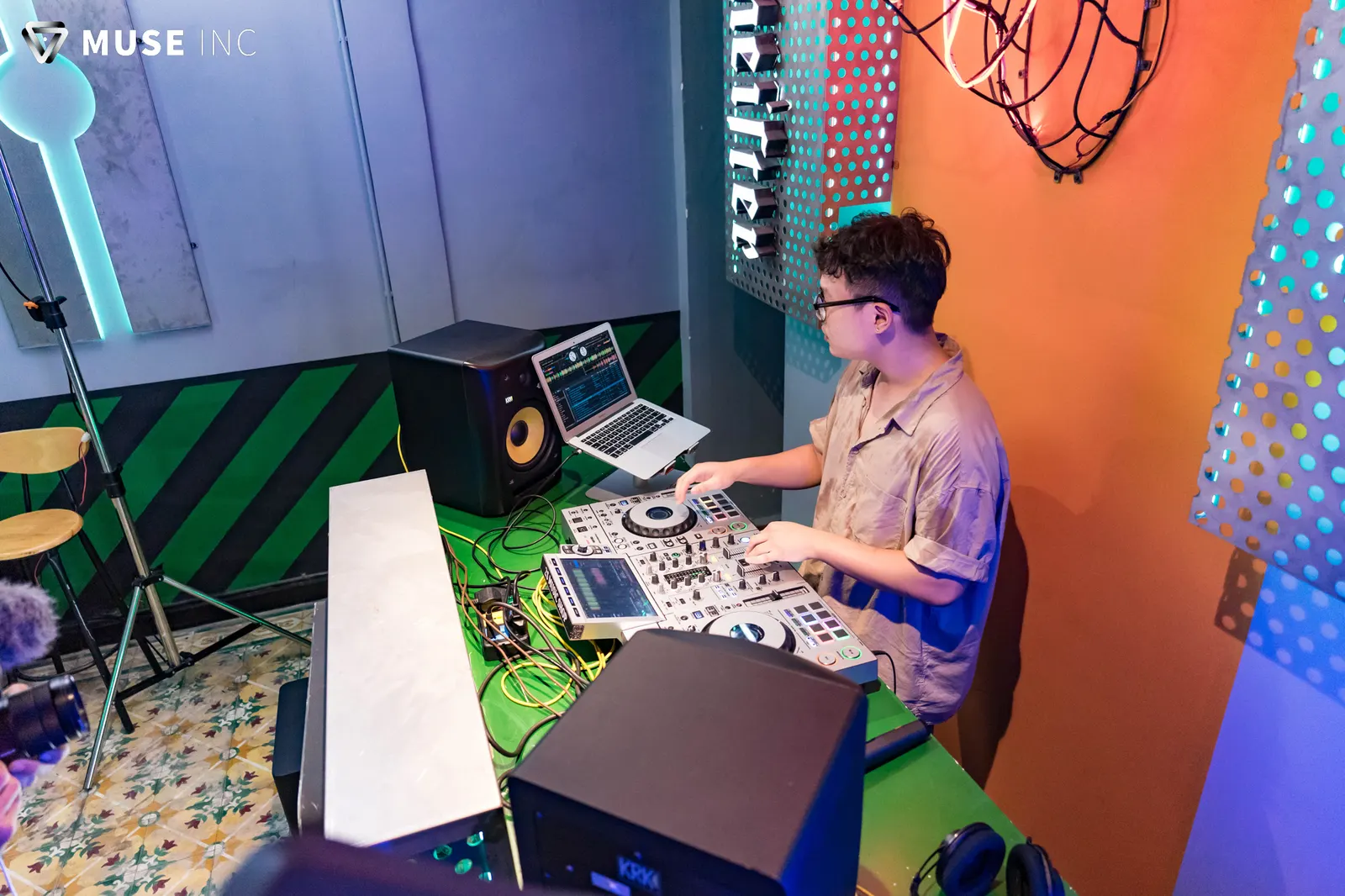
On the gear side, you'll meet four main setups: a controller (plugs into a laptop running software such as rekordbox or Serato), an all-in-one unit (such as the XDJ range, with USB playback), CDJs and a mixer (the club standard) and turntables for vinyl. Most beginners start on a controller and move up to CDJs later.
Is it hard to learn to DJ?
Honestly: the basics aren't hard; getting good is. How fast you improve depends far more on how you practise than on talent.
What beginners usually pick up quickly: the layout of the decks, playing and cueing tracks in headphones, matching tempos with the software's help, and simple transitions. What takes longer: beatmatching by ear without looking at waveforms or hitting Sync, feeling song structure so you mix on the phrase, and choosing the right next track for the room.
For a sense of scale: on our Basic course, students can do basic mixes and build their first 15-minute set after 9 sessions (about 3 weeks). Beatmatching by ear at 75–150 BPM, harmonic mixing with the Camelot wheel and playing a confident 60-minute set takes our Comprehensive DJ Course about 3 months and 33 lessons with a teacher. For a closer look at timing and cost, see how long learning to DJ takes and what it costs.
The 8-step path
Order matters. This is the path we recommend, and it's close to how our Level 1 Basic DJ course is built. Don't skip ahead: each step is the foundation for the next.
Step 1: Listen and choose your music
Before you touch the decks, learn to listen like a DJ. Count the beats along with the kick drum, and notice where a track's intro, peak and outro are. Pay attention to tempo too: house and EDM usually sit around 120–128 BPM, while pop and hip-hop run much slower. Start with a small library of 30–50 tracks you genuinely love, in one or two genres, and keep your playlists tidy from day one.
Step 2: Get to know the decks
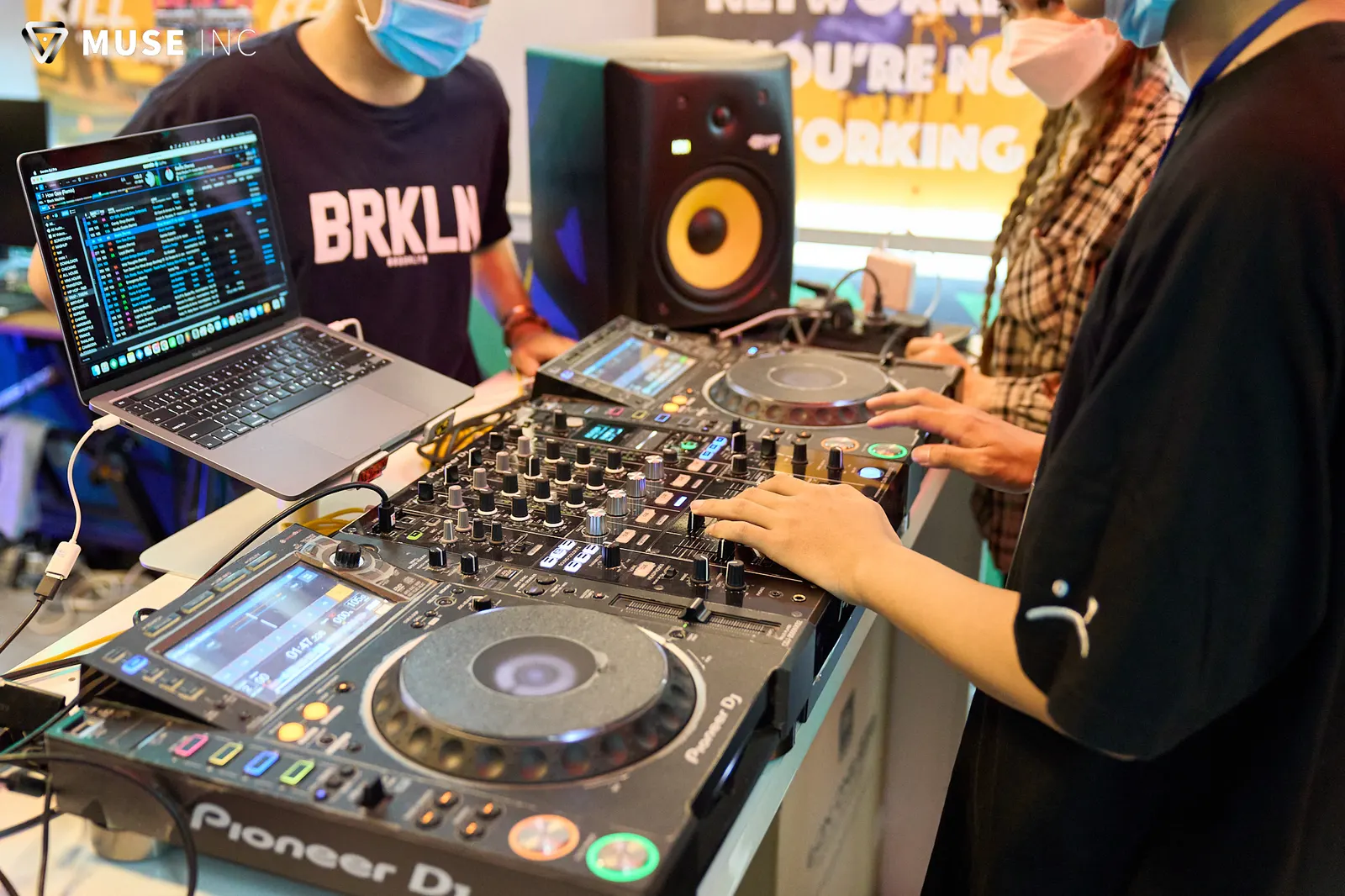
Every setup, controller or CDJ, has two halves. The decks give you jog wheels, play and cue buttons, a pitch fader for tempo and hot cues. The mixer gives you gain, three EQ bands (low, mid, high), channel faders, a crossfader and the headphone cue section. Our students learn rekordbox and Serato DJ. The goal is to work the controls without looking.
Step 3: Beatmatching
Beatmatching means matching the tempo and phase of the incoming track to the one that's playing, so both kick drums land together. You listen to the new track in your headphones, set the pitch fader to the same tempo, then nudge the jog wheel until the beats line up. Sync can do this in a second, but we still teach it by ear: when Sync gets it wrong, or you're on unfamiliar gear, your ears are all you have. More on why beatmatching by ear still matters.
Step 4: Phrasing and song structure
Most dance and pop music is built in phrases of 8, 16 or 32 beats. Phrasing means starting your transition at the top of a phrase, so the new intro lines up with the old outro and the drop lands when the crowd expects it. Two tracks can be perfectly beatmatched and still sound wrong if the phrases clash, and that's the most common beginner mistake. Our post on the 2 song structures every DJ should know goes deeper.
Step 5: EQ and transitions
With two tracks playing, the low end piles up fast. Rule one: never run two basslines at full. Cut the lows on the incoming track, bring it in, then swap the bass at the start of a phrase, and keep your gain out of the red. From there you add more transitions: long blends for house, quick cuts for hip-hop, echo-outs when you need to change tempo.
Step 6: Effects and loops
Effects (filter, echo, reverb) and loops smooth transitions and add accents. A loop is a lifesaver when an intro is too short: repeat 4 or 8 beats and buy yourself time. Use them sparingly: one well-placed echo beats ten stacked effects.
Step 7: Build your first 30-minute set
Once your transitions are steady, string them into a set. Level 1 students build their first 15-minute set; a sensible next goal is 30 minutes, roughly 8–10 tracks, with a clear energy arc: start gently, build, peak, then bring it down. Record every set and listen back: you'll hear the mistakes you missed while playing.
Step 8: Perform
Playing for people is the real test. Start with friends or a small party, then bigger rooms. Bring your own headphones and a backup USB, look at the crowd more than the screen, and share your mixes online for feedback. At Muse Inc, every course ends with a graduation set at Markshow, in front of a live audience and judges.
When to start
There's no perfect moment: start when you can practise regularly for several weeks in a row. Working full-time? Pick a fixed evening slot; we're open 9:00–21:00 every day, and our DJ After Hours course (5 evening sessions) is built around office hours. Kids aged 6–14 have their own course on controllers.
Why learn to DJ
Even if you never play a paid gig, DJing pays off. You'll hear music differently, picking up structure and rhythm you never noticed. Mixing two tracks at once is a real focus workout and a great way to switch off after work, and you'll meet people who love the same music at workshops and community events.
What you need
For lessons at our studio, nothing but yourself. You learn on the school's controllers, XDJs, CDJs and turntables. Bring your own headphones (6.3 mm or 3.5 mm plug) and a USB stick with music you like. For online lessons, you need a laptop and a controller. To practise at home, a 2-channel controller, laptop, headphones and a pair of monitors is plenty to start; you can compare DJ controllers and players in the school store before you buy.
Teach yourself or take lessons?
You can absolutely teach yourself: it's cheap, flexible and there's lots of free material. The catch is that nobody points out your mistakes, bad habits set in (leaning on Sync, gain in the red, mixing off the phrase), and you rarely get time on club gear. We've written a separate guide on teaching yourself to DJ on a laptop or phone.
Lessons get you there faster: a clear path with tests, working DJs correcting you on the spot, Pioneer DJ club gear such as the CDJ-3000 and DJM-A9, and practice hours included.
Our Level 1 — Basic DJ course is 9 sessions (8 lessons with a teacher plus a test) and 8 practice hours on a controller. It costs 8,000,000 VND (about $310) in a group of up to 4 or online, or 9,500,000 VND (about $365) one-on-one. Lessons are in Vietnamese or English, and the lesson slides in your student account come in both languages. The school is at the back of 409 Hai Bà Trưng, Xuân Hòa Ward (District 3). Curious first? Preview the "Introduction to DJ" lesson for free.
USD figures are approximate, at about 26,000 VND to the dollar.
FAQ
Yes. The Basic course starts from the gear, the software and how to hear the beat.
Our Level 1 course is 9 sessions over about 3 weeks. The full path from zero to a graduation show is about 3 months on the Comprehensive DJ Course.
No. You learn on the school's gear. Take a few lessons before buying, so you know what suits you.
Yes. The first lesson, "Introduction to DJ", is a free trial: pick an open slot on our website and a teacher meets you at the school for an hour.
Yes, in Vietnamese or English.
Ready for your first mix? Book a free trial lesson at Muse Inc, open 9:00–21:00 every day, or message us on Zalo at 0902 957 911.